
Best business structure for foreigners in Vietnam in 2026
- 11/10/2026
Do you want to starting a business in vietnam as a foreigner ? How to start a small business in Vietnam? What type of entity is best suited to you and how to overcome risks in small businesses? Discover our services with leading Vietnamese lawyers and Ho Chi Minh, Da Nang and Hanoi offices →

 CONTENT
Choosing the right business structure in Vietnam as a foreigner
The best business structure for foreigners in Vietnam is rarely the one with the most features. It is the one that lets you do exactly what you plan to do, at the lowest compliance cost, without forcing a restructure 2 years later.
That sounds obvious. In practice, foreign investors often pick a structure by habit. A parent company abroad uses a branch network, so it asks for a branch. A founder hears that representative offices are cheap, so they start there, then discover they cannot invoice a single customer.
This page compares the options by what each one is legally allowed to do. It does not cover filing steps, documents or costs. For the procedure itself, see the guide to set up company in Vietnam.
What business structures can foreigners choose in Vietnam?
There are 2 families of options, and the difference between them matters more than any detail inside them.
Vietnamese legal entities. A company incorporated in Vietnam under the Law on Enterprises 2020. It has its own legal personality, its own tax code and its own liability. For foreign investors, this almost always means a limited liability company (LLC) or a joint stock company (JSC).
Extensions of a foreign company. A representative office or a branch, licensed under Decree 07/2016/ND-CP. Neither is a separate legal entity. Both act on behalf of the foreign parent, which remains responsible for them.
|
Structure |
Separate legal entity? |
Can earn revenue in Vietnam? |
Main legal basis |
|
Single-member LLC |
Yes |
Yes |
Law on Enterprises 2020, Chapter III |
|
Multi-member LLC |
Yes |
Yes |
Law on Enterprises 2020, Chapter III |
|
Joint stock company |
Yes |
Yes |
Law on Enterprises 2020, Chapter V |
|
Representative office |
No |
No |
Decree 07/2016/ND-CP |
|
Branch |
No |
Yes, within licensed scope |
Decree 07/2016/ND-CP |
Private enterprises and partnerships also exist under Vietnamese law. They are rarely suitable for foreign investors and are not discussed here.
The split also shapes the tax footprint. A representative office has no revenue of its own, so it does not carry corporate income tax on sales, although it must still handle personal income tax for its staff. A branch and a subsidiary both earn income in Vietnam and are taxed on it. When people search for the best business structure for foreigners in Vietnam, this is often the first practical difference they need to see.
Limited liability company (LLC) vs joint stock company (JSC)
Both are companies with limited liability. The differences lie in who can own them, how ownership moves, and how much governance they require.
|
Point |
LLC |
JSC |
|
Number of owners |
1 (single-member) or 2 to 50 (multi-member, Article 46) |
At least 3, no maximum (Article 111) |
|
Can issue shares? |
No, except to convert into a JSC (Articles 46.4 and 74.4) |
Yes |
|
Can issue bonds? |
Yes |
Yes |
|
Transfer of ownership |
Multi-member LLC: existing members get first right to buy (Article 52) |
Freely transferable, but founding shareholders face a 3-year restriction among themselves and to outsiders (Article 120.3) |
|
Governance |
Owner or members' council; simple |
General meeting plus board, or another model under Article 137 |
|
Capital contribution deadline |
90 days from enterprise registration (Articles 47.2 and 75.2) |
90 days from enterprise registration (Article 113.1) |
A practical reading of the table: an LLC is built for control, a JSC for capital raising. For most first-time investors, the best business structure for foreigners in Vietnam turns out to be the simpler of the two.
Most foreign parent companies set up a single-member LLC. When the owner is an organization, Article 79 lets it choose between a company chairman model and a members' council model, which gives a group with a regional office a light structure that still mirrors its internal approvals.
A JSC earns its extra governance only when shares will actually move: outside investors, employee share plans, or a long-term listing plan. Otherwise, it is overhead.
If your decision turns mainly on how many investors you have and whether you will fundraise, the separate guide on choosing the right business entity in Vietnam works through that question in more depth.
When should foreign investors choose a representative office?
A representative office is a listening post. Under Article 30 of Decree 07/2016/ND-CP, its activities are confined to liaison, market research and promoting the parent company's business. It cannot carry out profit-generating activities.
The entry conditions are modest. The foreign trader must have operated for at least 1 year (Article 7), and the license is issued for 5 years, capped by the remaining validity of the parent's own registration (Article 9). Licensing sits with the provincial Department of Industry and Trade, or with the management board where the office is inside an industrial park, economic zone or high-tech zone (Article 5).
A representative office makes sense when:
- You are still testing whether Vietnam is worth a full investment.
- You need staff on the ground to manage suppliers or distributors, while contracts are signed by the parent abroad.
- You want a visible presence for marketing before revenue starts.
It does not make sense when you need to invoice Vietnamese customers, hold inventory, or employ a sales team that closes deals locally.
There is also an exit point to plan for. A representative office cannot be "upgraded" into a company. When the business is ready to trade, the investor sets up a new company and, usually, closes the office. Budget for both steps if you expect the office to be temporary.
Consider an Australian education technology company. It hires 2 people in Ho Chi Minh City to meet schools and gather feedback, while licenses are sold by the Australian entity. A representative office fits perfectly. The day a Vietnamese school wants a local contract and a VAT invoice, it no longer does.
Branch vs subsidiary: key differences
A branch is the parent company operating directly in Vietnam. A subsidiary is a separate Vietnamese company that the parent owns.
|
Point |
Branch |
Subsidiary (LLC or JSC) |
|
Legal status |
Part of the foreign parent |
Independent Vietnamese legal entity |
|
Liability |
Parent is directly liable |
Limited to the subsidiary's capital |
|
Parent's operating history |
At least 5 years (Article 8, Decree 07/2016/ND-CP) |
No minimum |
|
Business scope |
Limited to Vietnam's treaty commitments and the parent's business lines (Article 8.4) |
Any activity permitted under market access rules |
|
License term |
5 years, capped by the parent's registration (Article 9) |
No fixed term for the enterprise |
|
Typical users |
Banks, insurers and certain regulated services |
Almost everyone else |
The 5-year history requirement alone excludes many investors. The scope rule excludes many more, because only certain service sectors are committed for branch presence. In ordinary trading, manufacturing and consulting, a branch is usually not the available or the sensible route.
Liability is the other deciding point. A dispute or tax claim against a branch reaches the parent directly. With a subsidiary, exposure stays inside Vietnam.
How to choose a business structure based on your goals
The best business structure for foreigners in Vietnam follows the activity, not the investor's home-country habits. Here is how the choice usually plays out.
Small businesses and consulting services
A single-member LLC is the default. One foreign individual or one parent company owns it, decisions are fast, and the compliance load is the lightest of any operating structure.
Take a British management consultant moving to Da Nang. She wants to contract directly with Vietnamese clients. A representative office cannot do that. A single-member LLC owned by her personally can, with her as legal representative, provided she resides in Vietnam as Article 12.3 of the Law on Enterprises 2020 requires for at least 1 legal representative.
When 2 or 3 professionals start together, a multi-member LLC keeps control inside the group. Article 52 gives existing members the first right to buy any departing member's stake, which stops shares drifting to outsiders.
Trading and import-export businesses
Trading needs an operating company. The choice is usually between a single-member LLC owned by the parent and a multi-member LLC with a local or regional partner.
Watch the business lines. Wholesale and import-export are generally open to foreign investors. Retail to consumers requires a separate business license under Decree 09/2018/ND-CP, and opening further outlets may require an economic needs test. The structure does not change those rules, but it changes who holds the license and who carries the liability.
Consider a Korean trading house with 3 partners from different family branches. A multi-member LLC gives each a defined stake with first-refusal protection. A JSC would only be worth it if the group expects to bring in investors from outside.
Manufacturing and technology companies
Manufacturing almost always calls for a subsidiary. Factory leases, import of machinery, environmental approvals and investment incentives all attach to a Vietnamese legal entity with an investment project.
Technology companies face a fork. A software development centre serving the parent is a natural single-member LLC. A startup planning funding rounds, employee share options or an eventual listing should look at a JSC early, because converting later means a second round of registration and shareholder paperwork.
A German machinery maker that needs local assembly and after-sales service is a clear subsidiary case. A branch would expose the German parent to every claim in Vietnam, and its activities may fall outside the scope committed for branches anyway.
Ownership, liability and management considerations
Three questions cut across every structure.
Who will own it, directly or through a holding company? Many groups hold their Vietnamese subsidiary through a regional holding company. That choice affects which treaty applies to the investor's market access and how beneficial ownership must be declared. Since Decree 296/2026/ND-CP took effect on 23 July 2026, every layer must be traced to the individuals at the top, and holding capital on behalf of someone else is expressly prohibited.
Who will be on the ground? Every company needs at least 1 legal representative residing in Vietnam. If the owner lives abroad, plan for a resident director from the start, along with the work permit and residence card that person will need.
How much liability can the parent accept? Subsidiaries ring-fence risk in Vietnam. Branches and representative offices do not. For a parent with significant assets, that difference alone often settles the question.
100% ownership or a joint venture?
Ownership share is a structural choice too. In most sectors a foreign investor may hold 100% of the company. A joint venture with a Vietnamese partner is then optional, chosen for the partner's licenses, premises, customer base or knowledge of local procedure.
The trade-off is control. A 70/30 joint venture LLC means a members' council where the minority can still block decisions that the charter reserves for a higher voting threshold. Draft those thresholds deliberately, not from a template.
One more point. Market access rules sit above all of this. If a sector requires a Vietnamese joint venture partner or caps foreign ownership, it narrows the structure options before any preference comes into play.
What to decide before registering your company?
Before you file anything, write down clear answers to 5 questions. Together they point to the best business structure for foreigners in Vietnam for your plan:
- Will the Vietnamese presence earn revenue locally, or only support the parent?
- Who are the owners, and will new investors join in the next 3 years?
- Which exact business activities will it carry out?
- Who will be the legal representative living in Vietnam?
- How much liability is the parent prepared to carry in Vietnam?
If the answer to question 1 is "no revenue yet", start with a representative office. If question 2 points to outside investors, look hard at a JSC. In almost every other case, the answer is an LLC.
Changing later is possible. A representative office can be closed and replaced by a company, and an LLC can be converted into a JSC. But each change is a new procedure, and choosing correctly at the start is usually the cheaper path.
Frequently asked questions about business structures in Vietnam
What is the best business structure for foreigners in Vietnam?
For most foreign investors, a single-member LLC. It allows full trading activity, limits liability, and keeps governance simple. A JSC is better when outside investors will come in. A representative office suits market research only.
Can a foreign individual own a company in Vietnam without a local partner?
Yes, in most sectors. A local partner is needed only where market access rules require a joint venture or cap foreign ownership.
Can a representative office sign contracts with Vietnamese customers?
Not for its own revenue. Under Decree 07/2016/ND-CP, its role is limited to liaison, market research and promotion for the parent company.
Is a branch cheaper than a subsidiary?
Not necessarily. A branch requires a parent with at least 5 years of operation, is limited to committed sectors, and exposes the parent to direct liability. For most investors, it is not the cheaper route once risk is counted.
Can I change the structure later?
Yes. An LLC can convert into a JSC, and a representative office can be closed after a company is formed. Each change is a separate procedure, so the initial choice still matters.
Talk the structure through before you commit
A 30-minute discussion of the 5 questions above usually settles which is the best business structure for foreigners in Vietnam in your particular case. LHD Law Firm reviews business plans for foreign investors and recommends the structure, ownership chain and legal representative arrangement before any filing starts.
- Ho Chi Minh City: HP Tower, Floor 7, 60 Nguyen Van Thu Street, Tan Dinh Ward. Tel: +84 28 2244 6739. Email: all@lhdfirm.com
- Ha Noi: Anh Minh Tower, Floor 4, 36 Hoang Cau Street, O Cho Dua Ward. Tel: +84 24 6260 4011. Email: hanoi@lhdfirm.com
- Da Nang: 71 Ly Tu Trong Street, Thach Thang Ward. Tel: +84 905 987 929. Email: danang@lhdfirm.com
Legal sources referenced: Law on Enterprises 2020 (Articles 12, 46, 47, 52, 74, 75, 79, 111, 113, 120, 137), Decree 07/2016/ND-CP (Articles 5, 7, 8, 9, 30), Decree 09/2018/ND-CP, Decree 296/2026/ND-CP.
Client's of LHD Law Firm
Hopefully, this article will help you know thoroughly about how to start a business in Vietnam as a foreigner. The above is two factors, in our opinion, it is also the two main difficulties of foreign businesses when they start their businesses in Vietnam. However, about corporate culture, you can gradually get used to but the law must be clear from the beginning. Therefore, if you want to be more clear about business laws when you start a business in Vietnam, you can contact with LHD Law Firm (Free Quotation and legal advise)

FAQs
A foreign investor (just like a local investor) may select one of the following Vietnamese legal entities to carry out a project:
- A limited liability company (“LLC”), in the form of either a single-member LLC (“SLLC”) or an LLC with two or more (up to a maximum of 50) members (“MLLC”).
- A shareholding or joint stock company (“JSC”) which is a company with at least three shareholders but no maximum number of shareholders.
- A general partnership or a limited liability partnership.
- A private enterprise (akin to a sole proprietorship).
The standard Vietnam corporate income tax (CIT) rate is 20%, though enterprises operating in the oil and gas sectors will be subject to rates between 32% and 50%;
Dividends paid by a Vietnamese company to its corporate shareholders will be completely tax exempt. Furthermore, no withholding tax will be imposed on dividends remitted to overseas corporate shareholders. For individual shareholders, the withholding tax will be 5%;
Interest payments and royalties paid to non-residents individuals or corporate entities will be subject to withholding tax of 5% and 10% respectively;
Personal income tax for residents is levied under a progressive system, ranging between 5% and 35%. However, for non-resident individuals, the tax is levied at a flat rate of 20%.
Yes, a company in Vietnam can be 100% foreign-owned in selected sectors.
Yes. As stated in Circular No: 23/2014/TT-NHNN and Circular No. 32/2016/TT-NHNN, a foreigner is considered eligible to open a bank account in Vietnam if they are permitted to stay in Vietnam and can provide the required documents:
The required documents to open a bank account in Vietnam may vary according to the bank, but will typically include:
- Valid passport with at least 6 months validity before its expiration date.
- One of the following valid documents with a validity of 1 year or greater, issued within the last 12 months:
- Valid visa with a duration of 1 year or greater issued within the last 12 months
- Temporary Resident Card (TRC)
- Work Permit
- Permanent Resident Card (PRC)
- Temporary residence confirmation issued by the police
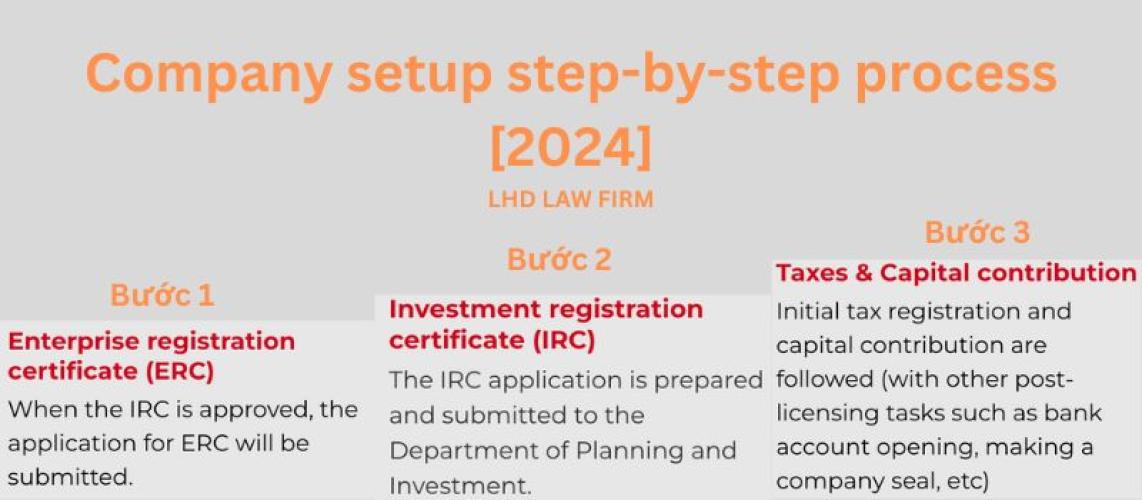
The process to register a company involves 5 steps.
- Applying for an investment registration certificate (IRC).
- Applying for an enterprise registration certificate (ERC).
- Making and registering the company seal.
- Making a public announcement.
- Registering the tax code/ VAT number with the tax department.
This is the standard process to register a company to operate any type of business in Vietnam. After this, depending on the nature of the business, the entity may or may not require additional sub licenses.
Foreigners are allowed to register their company in Vietnam for starting a business.
In most industries, they can own 100% of the shares of their business. In a few selected industries, company registration in Vietnam is only allowed in a joint venture agreement with a Vietnamese individual or corporate shareholder.
7 comment
Limor Yron
Good day. I have an American passport, biz visa. Would like to open a bar restaurant in Mui Ne in a guest house. Would like to talk about legal options. Please what’s app or email +16464271429 Thank you Cam on Limor
Mitchell Boyd
Dear Sir/Madam, I'm planning to open a bar/hostel. I would appreciate some information if you would be so kind. Legal stand points. Many thanks, Mitchell Boyd
Alex Lim
Hello friends, My Vietnamese partner and I will open a dormitory business in Saigon. However, I hope someone can give me advice on paperwork, registration and legal issues. How and where do I register for business in Saigon? How long does this process take? What kinds of licenses do I need to get from the government? How can I get the license? through an agent, lawyer? How much does it take to obtain licenses and attorneys' fees to open a company? Your help will be much appreciated. :) Best regards, Alex Lim
Loo Wei
Dear LHD Law Firm, I am interested to establish a company in Ho Chi Minh City and would like to know more about the procedures and processes. Also, I would like to find out the duration needed for such a registration and the fee structure of LHD Law Firm to assist the setup. 1) I would like to establish a LLC in Vietnam that will be fully owned by my holding company incorporated in the British Virgin Islands. Are there any restrictions to using a holding company to establish an LLC in Vietnam? 2) I have been in the management and consultancy business in the oil and gas and petrochemicals sector and have been in the industry for over 23 years. The incorporated company will be used to provide management and advisory services to downstream and mid-stream corporations that are looking for entry into Vietnam. What are the fee structures and paid up capital requirements for such a LLC license? Is the company allowed to open and maintain a local VND currency bank account? 3) With a Vietnam LLC, what are the reporting and tax filing requirements? As there a new startup, the business will not be generating much revenue until at least 2 years later. Do the tax authorities consider taxation on expenditure as well from the first year, even for new companies that do not yet earn any profit? 4) With a fully foreign owned LLC in Vietnam, is there a requirement to appoint a Vietnam representative or employee? Can the Managing Director be a foreigner? As an investor, will that foreigner be allowed multiple entry into Vietnam under an investment pass? Is there a minimum salary expected for the local and foreign representative? 5) As the rents in Ho Chi Minh city area are quite high, is the LLC allowed to purchase its own office space to operate its business from there? 6) If an LLC is registered in Ho Chi Minh City, does that mean the company cannot conduct business in Hanoi? Can the company legally enter into a contract with a Hanoi or Danang company? I will be visiting HCMC regularly and will appreciate your thoughts on the above. If possible, I would also be available on 20th June to meet up in the morning at your office to discuss this further. Looking forward to your reply.
Rajat Roy
Sir,I rajat here I live in India,I need a job, Any vacancy for me, I am based in printing line Last twelve years. and still now working in duplo digital duplicate machine, this machine are high speed printing machine.i am sales and repearing. And my previous work experience is photo copy machine repair and sales ten years experience. Thanks Regards Rajat Roy
Atul Mittal
Interested to open a trading company in Vietnam in Henoi.
Vogle
Dear recipient, I just finished a live that on your website and I would like to get a quote from you for some services regarding setting up a 100% foreign owned company in Nha Trang, Vietnam. My Name is Jørn-Inge Sund I have a friend that I have been working together with at a previous employer. He has a company in Norway that does outsourcing and own R&D work. Now, he wants to expand and open a company here in Vietnam aswell. I have been living in Vietnam for nearly 5 years, and working here so he wants me to be the GM of his company. He personally (or his Norwegian company that he also owns 100% of the shares, depending on what is best/easiest) will be the owner, with 100% of the shares. single member, LLC company. The proposed name we want for the Vietnamese company is “Velox Tech Co., Ltd.” (the same as the Norwegian) We do have a business address, and we have an accountant that has been working at a bank the last 10 years, so what we want a price for doing is: 1. Help with Investment license Help with Business registration Help with Tax registration 2. I, myself have an investment company in Vietnam together with a Vietnamese friend, and I have a TRC valid until 02.2020. I also have an exemption letter for work permit with that company. I will need a work permit for the new company and a TRC extension aswell. Could you please give me a quote of these service, and a approximate time frame of the process from start to finish? Please make the quote in 2 parts, specifying the price for part 1 and 2 separately Thank you in advance for your reply.
Send comment
Others Post
So what investment incentives does Vietnam actually offer ...
What hiring employees in Vietnam actually requires after ...
How long does IRC processing take in Vietnam?
Business license Vietnam: The step most founders miss after ...
Foreign investment mistakes Vietnam investors keep repeating
Choosing the right business entity Vietnam: How founders should ...
Registered office Vietnam: What the law actually requires
Legal representative requirements in Vietnam: what foreign ...
Temporary residence card Vietnam rules for investors work ...
Work permit Vietnam rules just changed, and most employers haven
+68889+
+16889+
+39+
3+
REGISTER
SEARCH POST